
Senior Consultant · Manipal Hospital Salt Lake · Kolkata
When a gynaecological cancer diagnosis arrives, the need for clarity — and for a surgeon who will be completely honest — becomes urgent. Dr Manas Chakrabarti built his entire practice around exactly that moment.
Trained for over a decade inside the United Kingdom's NHS — earning the prestigious Consultant Certificate of Completion of Training (CCT) followed by a specialist Fellowship in gynaecological oncology surgery — he returned to Kolkata with a single purpose: to bring internationally comparable, evidence-based cancer care to women across Eastern and North India, without them needing to travel abroad.
"Evidence, ethics, and empathy" — the three principles that guide every decision, from first consultation to final follow-up.

Few gynaecological oncologists practising in Eastern India hold a structured NHS Consultant qualification — let alone a dedicated post-consultant Fellowship in oncology surgery. Dr Chakrabarti does. Here is the journey.
Graduated MBBS from Medical College & Hospital, Calcutta — one of India's oldest and most respected institutions — and completed his DGO there. A grounding in obstetrics and gynaecology across Bengal's complex clinical landscape shaped a physician who would always put the whole patient first.
Dr Chakrabarti was awarded the National Training Number — the most competitive entry into the NHS specialist registrar programme. He trained across the Greater Manchester Cancer Network, passed the MRCOG in 2010 (the gold-standard UK gynaecology exit exam), held a management leadership qualification from Manchester Business School, and tutored students at the University of Manchester.
NHS North West Deanery · Greater ManchesterThe CCT is the formal NHS qualification authorising independent consultant practice in the UK. It is awarded only after a full structured programme, assessed by the Royal College of Obstetricians and Gynaecologists. Dr Chakrabarti obtained his CCT in 2013 — a standard held by fewer than a handful of gynaecologists currently practising in Eastern India.
After qualifying as a Consultant, Dr Chakrabarti pursued an additional post-consultant oncology surgical Fellowship at the East Kent Gynaecological Oncology Centre — one of the UK's most respected specialist units. He trained under Mr Andrew J Nordin FRCOG (President, British Gynaecological Cancer Society; National Cancer Clinical Lead; Chair of the National Cancer Intelligence Network) in the celebrated surgical tradition of Dr John Monaghan, the father of modern radical gynaecological oncology surgery. He also trained in complex colorectal oncology under the unit's lead surgeon. This Fellowship places him among a very small global cohort with both full NHS Consultant status and a dedicated post-consultant oncology surgical training.
East Kent Gynaecological Oncology Centre · NHS TrustReturning to Kolkata, Dr Chakrabarti established the first internationally comparable gynaecological cancer department in a corporate hospital in Eastern India at Apollo Gleneagles Cancer Hospital — bringing robotic and laparoscopic oncosurgery, multidisciplinary tumour boards, sentinel lymph node mapping, and fertility-preserving oncology to the region. He now practises at Manipal Hospital Salt Lake and Salt Lake City Medical Centre, running a service modelled on the NHS multidisciplinary team approach.
Manipal Hospital Salt Lake, KolkataIn 2025, Dr Chakrabarti was admitted to the Fellowship of the Royal College of Obstetricians and Gynaecologists (FRCOG) — the highest membership grade of the UK's leading specialist college, recognising sustained excellence, contribution to the specialty, and international standing. It is held by very few gynaecological oncologists in India.
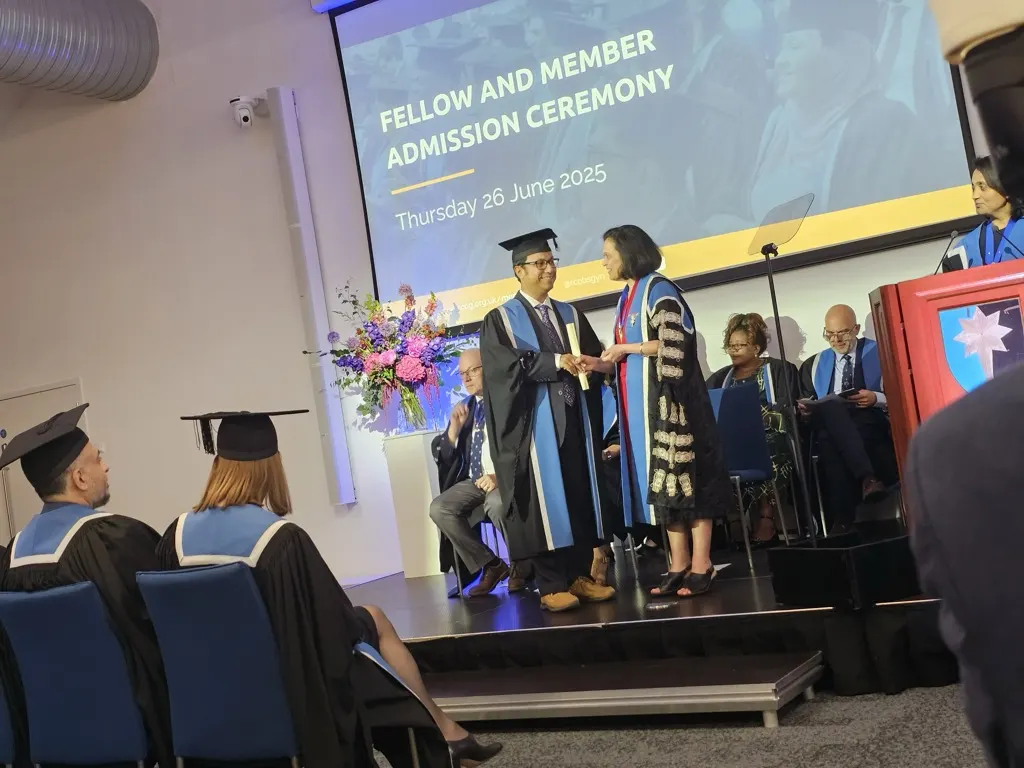
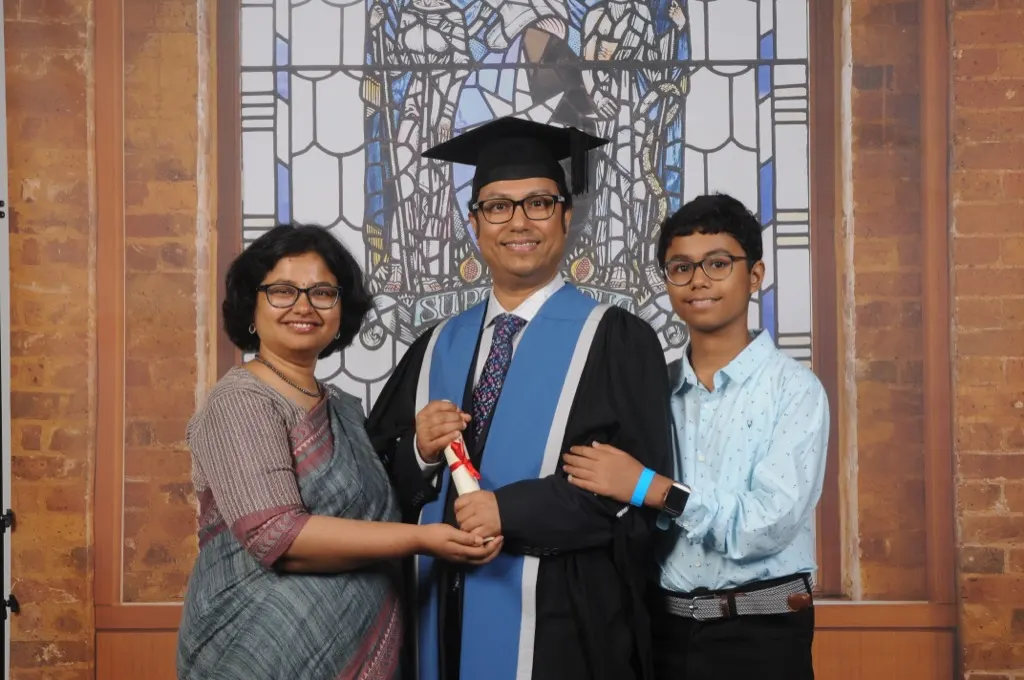
Choosing a surgeon for a gynaecological cancer diagnosis is among the most consequential decisions a patient or family will ever make. The qualifications below represent more than certificates — they reflect a deliberate, decades-long commitment to training at the highest possible standard.
| 2025 |
Highest Grade FRCOG — Fellowship of the Royal College of Obstetricians & Gynaecologists, London |
| 2013 |
NHS Consultant Status CCT — Certificate of Completion of Training, North West Deanery, UK |
| 2015 |
Da Vinci Robotic Console Surgeon Certified — Intuitive Surgical, Melle, Belgium |
| 2013–15 |
Post-Consultant Fellowship Gynaecological Oncology Surgery — East Kent Gynaecological Oncology Centre, UK |
| 2010 | MRCOG — Royal College of Obstetricians & Gynaecologists, London |
| 2012 | MOET — Managing Obstetric Emergencies & Trauma |
| 2010 | DFFP — Diploma, Faculty of Family Planning, RCOG |
| 2003 | DGO — Eden Hospital / Medical College, Calcutta |
| 2000 | MBBS — Medical College & Hospital, Calcutta |
Every recommendation Dr Chakrabarti makes is grounded in the best current evidence — whether that is an ESGO guideline, a Cochrane systematic review, or Phase III trial data. He is a Cochrane peer reviewer, co-author of Cochrane systematic reviews, and an EORTC Country Principal Investigator. He reads the science so you don't have to navigate it alone. When the evidence is uncertain, he says so — clearly.
Dr Chakrabarti was a Founder Member of the Institutional Ethics Committee at Salt Lake City Medical Centre — a role reflecting a long-standing commitment to doing the right thing, not just the convenient thing. In a field where patients are at their most vulnerable, he believes honest, unambiguous communication about prognosis is as important as surgical skill. He does not overstate what surgery can achieve.
A cancer diagnosis changes everything — not just medically, but emotionally and for the family around the patient. Dr Chakrabarti has maintained high patient satisfaction even in the most difficult situations, including advanced-disease and end-of-life care. His quality-of-life research with the EORTC reflects a genuine conviction that survivorship — how you live after cancer — matters as much as the surgery itself.
Great surgeons do not just operate — they ask the questions that improve outcomes for patients everywhere. Dr Chakrabarti's research spans EORTC quality-of-life science, Cochrane systematic reviews, and peer-reviewed oncology surgery.
Large cancer hospitals have many strengths — and Dr Chakrabarti has trained in some of the best. But for many patients, a dedicated specialist practice offers something different: consistent, personal attention from a single surgeon who knows your case entirely, without the system pressures that high patient volumes create.
| What matters to you | With Dr Chakrabarti's team | Typical large oncology centre |
|---|---|---|
| Continuity of care | Same surgeon at every consultation, pre-op, surgery, and follow-up | Rotation of junior doctors is common; consultant face-time may be limited |
| Consultation time | Unhurried appointments; questions are welcomed and answered in full | High-throughput OPD; consultation windows are typically brief |
| Surgical training lineage | Full NHS CCT + post-consultant Fellowship in dedicated UK gynae oncology surgical centre | Variable; depends entirely on individual surgeon's background |
| Multidisciplinary input | NHS-modelled Multidisciplinary Surgery approach; access to East Kent Oncology Centre team for complex cases | MDTs available but scheduling delays are common |
| Quality of life focus | Active EORTC researcher in cancer survivorship; this shapes every clinical decision | Curative intent is primary; survivorship support varies widely |
| Minimally invasive / robotic surgery | Certified Da Vinci robotic console surgeon; offered where clinically appropriate | Robotic programmes exist but access depends on machine availability |
He spent over an hour with us at the very first appointment. He drew diagrams, explained the staging, told us exactly what surgery involved. We never felt rushed. That gave us the courage to proceed.
I came for a second opinion after being told surgery was too risky. Dr Chakrabarti reviewed everything and explained a different approach. I am three years post-surgery and doing well.
He never gave false hope — but he never gave up either. He explained every option honestly. For a young woman facing a diagnosis, that honesty was more reassuring than any promise.