Medicine is not yet an exact science, and every patient’s cancer journey reflects that complexity. In this reflective piece, Dr Manas Chakrabarti shares why cancer, especially ovarian cancer, can behave unpredictably, and why steady research and hope still matter for patients and families.
In this article
Interrupting the train of thoughts my mobile rang. I wasn’t going to pick it up as it was on international roaming. But I had to….
Is 2+2 = 4? 3+3= 6 ? Yes. At least that’s what I want my son to learn and gobble. Any other answer is arithmetically wrong. Is it any different to you?Life says something else!
Our car was cruising smoothly with a steady speedometer at 120 km for the last hour. We were going from Opatija to Zagreb airport. It is the same airport where Croatian football team landed after winning hearts at World Cup.
At Opatija…nice balcony garden. Just behind this, we had our meeting.
We were though leaving through Zagreb back to our home. My destination was Kolkata, most other members of the car were going to London and one to Brussels.
It is a luxury to be in a chauffeur driven car in Europe but that’s what organisers arranged for us , albeit with a cost to be shared between all of us. The driver was very chatty and told us how the huge smooth motorways were built over once war-torn country of Croatia.
Pure engineering marvel. No potholes, flawless viaducts, no shudders from tyres. Not even an intrusive cow or wobbly cycle rider. Only a mild humming sound that invites you to doze like a long forgotten childhood slumber.
The marriage between modern automobile and motorways is nearly perfect and a marvel of science. Science has become flawless , isn’t it ?
Interrupting the train of thoughts my mobile rang. I wasn’t going to pick it up as it was on international roaming. But I had to. One of my revered cancer specialists from Kolkata.
Not a good news. A patient, I operated on few years back has gone to coma suddenly and appears to be a fulminating second different disease! Immediately my journey turned in to an unpleasant one as I desperately wanted to reach Kolkata and be by the side of her family, all very well known to me.
We all expected that she would survive her fight with cancer well as her biopsy report after surgery indicated that she should have a favourable outcome. Indeed she did. And now something else strikes her.
She is now so sick that she apparently is not fit for any investigations even to know the exact nature of the new disease. My heart wrenched in agony and desperation. Why can’t we defeat diseases well?
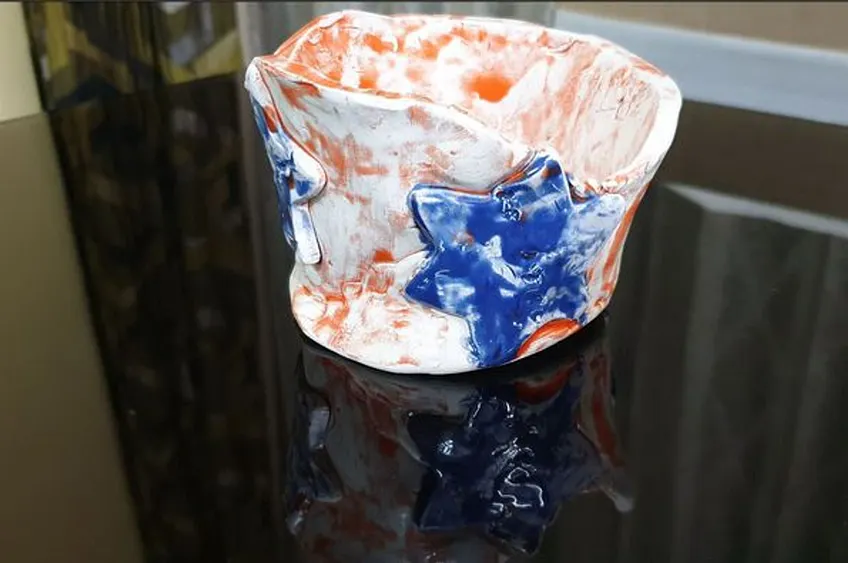
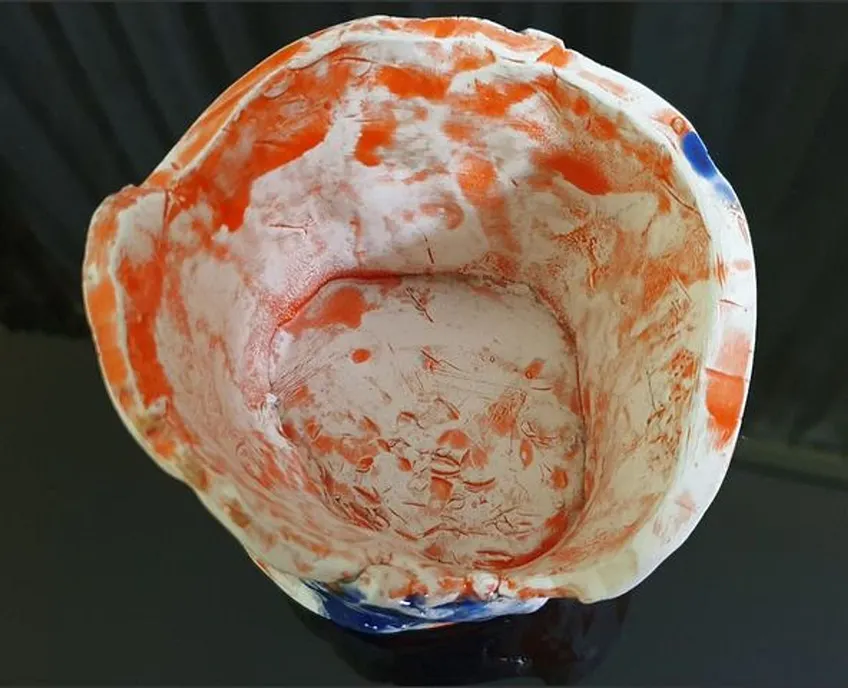
As I put my phone back into my rucksack, something else touched my fingers. A small hand-made earthen pot , I was gifted at the conference dinner the night before.
The iconic statue at Opatija City…just at the beach.
We came to Opatija in an international conference on Quality of Life of cancer survivors.
The night before, we had dinner at a small and cosy local family restaurant at Rijeka ( another town close to Opatija). As we cherished the outstanding ambience of the hall amidst Croatian live music, the local organising secretary gifted small earthen pots to all the delegates.
The pots landed on the dining table by the side of impeccably polished branded cutleries. Pots were made with love by physically challenged little Croatian children.
The pots were asymmetrical, uneven and unattractive by all mundane parameters and not fitting at all with the splendour of the interior or elegance of the branded utensils and cutleries. The meeting host unashamedly announced with pride this was to remind us how imperfect we all are.
I was surprised that apparently she planned this graceful ambiance and contrasted with the novice earthen pots and wanted to tell world leaders to accept imperfection.
Local family restaurant at Rijeka
Life is imperfect. The mere fact that you and I wear spectacles for clear vision loudly announces that we are imperfect. Our creations can be perfect but our life is imperfect. The Arthur Price cutleries we made, motorways we built, Rolls-Royce engines we crafted, can be perfect. However, we human beings stayed imperfect.
We should embrace imperfection with dignity but we must strive for perfection. In health science 2+2 can be 4 but may not be 4 always! It may be 3 or it may be a 5 too! Sometimes we give therapy which works successfully just as expected.
Sometimes the same medication works less than adequate for the same disease in a different person. The exact same medication can work like a miracle for exactly the same disease for another person.
Of course , most of the cases it works well but not for all. 2+2 cannot always be reproduced as 4 because human body is so so complex. Medicine is not an ‘exact science’ and far from being fully developed.
If I could talk to God I would pray to Her/Him please, please make Medicine an exact science where 2+2 will always be 4, every time , all the time !
Pots were made with love by physically challenged little Croatian children.
It is not going to come easily though. There was a time when we didn’t know the cause of lightening or rain. Now we know. There was a time when we didn’t know how to treat tuberculosis or small pox. Now we know.
What seemed to be unachievable in 1900 appears very attainable now. Cancer needs lot more endeavour, because it is so complex!
In tuberculosis the fight was against 1 bacteria. In small pox the fight was against 1 virus. Yet those fights took decades of endeavour.
While cancer can occur almost in any organ of a body. From skin to blood. Again, skin cancer has multiple subtypes, each behaves differently in different person. Take an example of ovarian cancer, one of the most complex cancers we have ever seen.
Every new recurrence of ovarian cancer can be of a different behaviour. Every time it responds to different chemotherapy. The way it fights back the chemotherapy or surgery is no less thrilling than a gripping Hollywood movie…
The novice earthen pots wanted to tell world leaders to accept imperfection.
Naturally, winning cancer is one of the most extensive battles human race can ever have! It is like 1000 tuberculosis battle.
We need more extensive research, more funds to find newer answers. I am optimistic. We have come a long way and doing lot better. Many cancers are winnable now.
We shouldn’t get distracted though. Hospitals with manicured garden is flashy , full page health advertisements on 20 newspapers are catchy. However, we must not all turn in to meager consumers of health care.
Unless we keep on searching for newer horizons, we have to continue on accepting imperfect health where 2+2 isn’t reliably 4 all the time. I’m more hopeful than ever before. The silver lining is getting stronger and brighter.
This is an impartial , unsponsored health information. For public awareness and not a replacement of Medical Advice.
Dr Manas Chakrabarti
Dr. Manas Chakrabarti is a leading consultant in Gynaecology and Gynaecologic Oncology based in Kolkata, India.
Renowned for his precision, compassion, and dedication to patient care, he has earned a stellar reputation for delivering treatment that meets and exceeds international standards.
With a strong academic foundation and years of clinical experience, Dr. Chakrabarti specializes in the management of complex gynecologic cancers, minimally invasive surgery, and advanced reproductive healthcare. His evidence-based approach and patient-centered ethics have made him a trusted name among both patients and peers.
Beyond clinical work, Dr. Chakrabarti is an avid educator and mentor. His scholarly articles, medical write-ups, and teaching sessions are widely appreciated by medical students and fellow practitioners alike for their clarity, depth, and practical insights.
Committed to continuous learning and innovation, Dr. Chakrabarti strives to bridge modern medical science with compassionate care—empowering patients, advancing education, and shaping the future of women’s health in India and beyond.
You are living longer, safer and healthier than any generation before you. Dr Manas Chakrabarti explores why fear often outpaces the facts, from ancient wars and plagues to modern medicine, and what that means for your health today.
Recovering from a hysterectomy raises many questions: when you can drive, return to work, exercise, and resume intimacy. This patient guide, by Dr Manas Chakrabarti, answers them calmly, week by week, so you know what is normal and when to call your surgeon.
Hysterectomy has a two-thousand-year history — from ancient Greece to today’s keyhole surgery. Along the way, one discovery changed everything: antibiotics. Understanding how far this operation has travelled can help any woman facing it feel more informed, more prepared, and less afraid. The past, it turns out, is genuinely reassuring.
Worried about radiation before a CT scan or X-ray? Everyday life already carries some background radiation, and medical scans are weighed against their real benefits. Dr Manas Chakrabarti explains in plain language how scan doses compare, and when a scan your doctor recommends is worth it.