What I have learnt is this: without the right understanding, it is remarkably easy to end up on entirely the wrong treatment path.

Menopause is behind you. Periods stopped years ago. You thought that chapter of your life was finished. And now the ultrasound report says there is a cyst on the ovary. The first question that pops into your head: is this cancer? The second: will I need surgery?
Take a breath. You are in the right place.
I am Dr Manas Chakrabarti, a gynaecological oncologist based in Kolkata. Over the past few decades I have operated on and guided patients with exactly this situation – from across India, the Middle East, and Europe.
What I have learnt is this: without the right understanding, it is remarkably easy to end up on entirely the wrong treatment path. And that, more than the cyst itself, is what causes harm.
In this article I will walk you through everything – step by step, in plain language. Why menopause changes the picture completely. What symptoms to watch for. How to get the right diagnosis. And exactly what treatment options exist, and when each applies.
By the end, you will know the right questions to ask your doctor – and whether the answers you are getting are correct. Knowledge, at the right moment, changes outcomes.
Let’s begin.
📋 Why Menopause Changes Everything
Before menopause, ovarian cysts are quite common. Many women in their forties develop them – they appear, they disappear, often without any real fuss.

But an ovarian cyst after menopause is unexpected. By that stage, the gynaecological organs are supposed to be quiet. The ovaries are not meant to be doing anything. That is precisely why the treatment strategy for a post-menopausal ovarian cyst is completely different from one found before menopause.
Think of it as a strategy shift. The same-sized cyst, found before versus after menopause, can call for an entirely different approach.
To understand why, you need to know how the strategy changes with menopause – across diagnosis, treatment, and the common ways things go wrong. But first, let me tell you what symptoms this kind of cyst can actually cause.
📋 Symptoms of Ovarian Cysts After Menopause
One rule to keep in mind from the start: you cannot diagnose an ovarian cyst on symptoms alone. Remembering that will save you a great deal of trouble.
◆ Most Cysts Are ‘Silent’
In most cases, these cysts or tumours sit quietly inside the abdomen for months, sometimes years, without causing any symptoms at all. They develop so slowly that they go unnoticed. I have written a separate piece on this – ‘The Belly That Swells in Silence’ – because the majority of problems stem from exactly this kind of silent cyst.
The trouble starts when that silent cyst suddenly becomes active. By then, there is no time to deliberate – the window for calm, considered treatment has already narrowed.
◆ What Does the Evidence Say?

The symptoms of typhoid or malaria have been studied for centuries. Yet the warning signs of complex ovarian problems were only taken seriously by the medical community after Barbara Goff’s landmark research in 2003. Many doctors resisted her findings at first. As a result, awareness remains insufficient – on both sides of the consultation table.
◆ What Are the Symptoms?
Here is the surprising part. There are no classic gynaecological symptoms. That is exactly why misdiagnosis is so common. What you do get looks much more like a digestive problem:
- Gradual abdominal bloating
- Gas, indigestion, or feeling full after eating very little
- Constipation or frequent urges to urinate
- Changes in bowel or bladder habits
If you stay observant, you may actually pick up on one or two of these yourself before your next appointment.
◆ What Should You Do?
Getting the right treatment at the right time means following international guidelines, step by step. That requires both patients and doctors to stay current. Detecting ovarian problems early enough remains one of medicine’s biggest challenges – precisely because they hide so well, for so long.
Barbara Goff’s research was once dismissed by the very doctors who needed it most. I wrote about this in a separate article on early ovarian cancer symptoms – the link is below for those who want to read further.
◆ Do Not Overlook Your Mental Health
A sudden diagnosis like this can shake anyone. But panic makes treatment harder, not easier. Many women, not wanting to worry their families, quietly keep what their doctor has told them to themselves. Problems grow in that silence.

Reassure yourself – and your loved ones – that with timely, proper treatment, you can absolutely plan that trip to Ladakh. What you need is not fear. What you need is confidence.
ℹ️ Diagnosing Ovarian Cysts After Menopause
◆ It Starts With an Ultrasound
When something feels off, the first diagnostic step is a good-quality ultrasound. In many cases, the cyst is actually discovered on a routine scan, with no symptoms at all – which leaves patients genuinely surprised.
On ultrasound, the first thing people look at is size. But what matters even more is whether the cyst shows features of a complex cyst.
There is plenty written on simple versus complex cysts – links are below. If a cyst is found, understanding that distinction is something you want crystal clear before you even walk into the doctor’s office. A simple cyst is, well, simple – and so is its management. A complex cyst can create real difficulties, and its treatment requires careful, considered planning.
Treating a complex cyst like a simple one is dangerous. Surgery can be left incomplete. Doing the opposite – applying complex-cyst protocols to a simple cyst – means unnecessary over-treatment.
◆ Then Come the Marker Tests
An ultrasound alone is not enough. Alongside it, certain tumour marker blood tests are essential. The word ‘tumour’ simply means swelling – even a mosquito bite is technically a tumour in Latin. So please do not assume that every cyst is cancer. But at this stage of life, these blood tests help establish why this cyst has appeared and which direction treatment should take.
A normal CA-125 does not mean treatment is unnecessary. Tumour markers – CA-125, CEA, CA 19-9, AFP – help indicate whether the problem is originating in the ovary, or whether what appears to be an ovarian cyst is actually a secondary sign of something else going on elsewhere in the body.
Interpreting these markers properly is genuinely complex – it took me several decades of study to get comfortable with it.
So do not walk into your appointment expecting a single marker number to determine your entire treatment plan. That is not how it works. These tests point us in the right direction. They do not give us the whole map on their own.
🗓️ When Do You Need Further Scanning?
If the tumour markers are abnormal, there is a family history of breast or ovarian cancer, or the ultrasound shows a complex cyst – rushing straight to surgery is the wrong move. Proper planning comes first, and that means advanced imaging. Depending on your situation, that could be an MRI or a CT scan.
One important point: always try to have these scans done with contrast injection. Yes, in rare cases there can be an allergic reaction to contrast. That is a real consideration. But a scan done without contrast gives incomplete information. And incomplete information leads to incomplete surgery.
In more complex situations, a CT scan of the abdomen is also needed. I have written a separate guide on which scan is used when – the link is below.
✅ Treatment of Ovarian Cysts After Menopause
My grandmother used to say: before you know who your friends are, find out who can hurt you. Modern medicine works the same way. Before planning treatment, you need to know what will not work.
Do not attempt to treat a post-menopausal ovarian cyst with hormone tablets, antibiotics, or supplement powders. Here is why. After menopause, the ovaries are no longer active – so hormone-based treatments that can shrink some pre-menopausal cysts simply do not work here. That is reason one.
Reason two is more serious. Wasting time on ineffective treatments means the real problem keeps growing while the window for effective action quietly closes.
◆ 1) Watchful Waiting as a Treatment Strategy
Sometimes the plan is simply to monitor the cyst and see if it resolves on its own. Not every ovarian cyst will cause problems. But this approach is not for everyone – it is governed by international guidelines.
If the cyst is small, not complex, and tumour markers are within the normal range, a period of monitored follow-up is entirely reasonable. The purpose is to check whether the cyst has any growth potential. If it grows, surgery is indicated. If it stays stable, some simple cysts can be managed with follow-up alone for years.
For patients without other concerns, follow-up at regular intervals over at least two years is the standard recommendation.
A critical point here: follow-up is a deliberate medical strategy, not a shrug. It does not mean your doctor is unconcerned. It does not mean you can forget about the cyst. It means we are assessing, over time, whether keeping it in place poses any long-term risk.
◆ 2) When Surgery Is Needed
If the cyst is complex, large, or associated with abnormal tumour markers, a family history of breast or ovarian cancer, or concerning findings on MRI or CT – watchful waiting is no longer safe. Surgery becomes the path forward.
Must Know Before Surgery: Limited or Complete?
There are two surgical options on the table. First, limited surgery – removing only the cyst, the fallopian tube on the same side, and the affected ovary. Second, complete surgery – removing all of the above, plus the uterus and the ovary on the opposite side. Which approach suits you is a conversation to have directly with your surgeon.
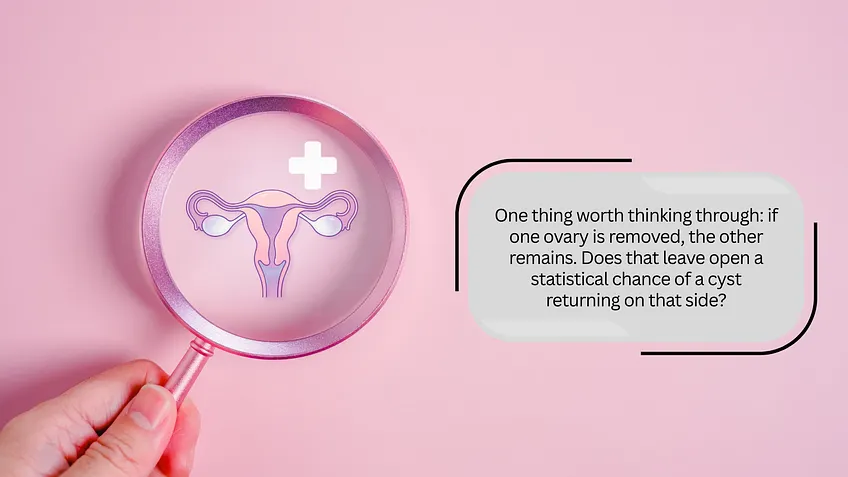
One thing worth thinking through: if one ovary is removed, the other remains. Does that leave open a statistical chance of a cyst returning on that side? Could a second surgery become necessary down the line? You want that question answered before the first one.
This is exactly why many surgeons, after a thorough discussion with the patient, opt to remove the uterus and the remaining ovary at the same time.
Must Know Before Surgery: Frozen Section Biopsy
There are several precautions to discuss with your doctor before going into theatre. One deserves special attention: if the cyst is complex, ask whether a frozen section biopsy will be performed during the operation.
Here is why this matters. A routine biopsy result arrives after you have gone home. If it later reveals borderline, pre-cancerous, or cancerous changes, a second surgery becomes necessary.
With a frozen section biopsy, we get preliminary results while you are still on the operating table. In approximately nine out of ten cases, this prevents the need for a second operation.
International guidelines define exactly which patients benefit most from frozen section. It is not routine for everyone – it takes time and adds cost. But if there is any doubt at all, doing it is simply the smarter call.
Must Know Before Surgery: No Room for Compromise
There are also important decisions around surgical technique – the type of stitching, whether to proceed laparoscopically, robotically, or with open surgery. These must all be discussed with your surgeon in advance.
Using open surgery where laparoscopy was appropriate slows recovery. Using laparoscopy or robotic surgery where open surgery was actually needed can allow the problem to spread within the abdomen – and also, rather unnecessarily, add to the hospital bill.

I will be publishing a detailed article on where patients commonly stumble in this process, and where compromising on these decisions can cause treatment to fail. Watch this space.
Good surgery requires cool-headed planning before the first incision. My approach for every patient is to work through the decision tree carefully – not just to remove the cyst completely, but to ensure you come back to a life worth living. Surgery is not the end goal. Life is.
Further Reading & Resources
Belly Swelling Silent Signs: 10 Causes & Tests | Dr Manas Chakrabarti
Ovarian Cancer Symptoms: Is Your Bloating a Warning? Dr Manas Chakrabarti
Ovarian Cancer Diagnosis Guide: Avoid Misdiagnosis | Dr Manas Chakrabarti
This is an impartial , unsponsored health information. For public awareness and not a replacement of Medical Advice.

